

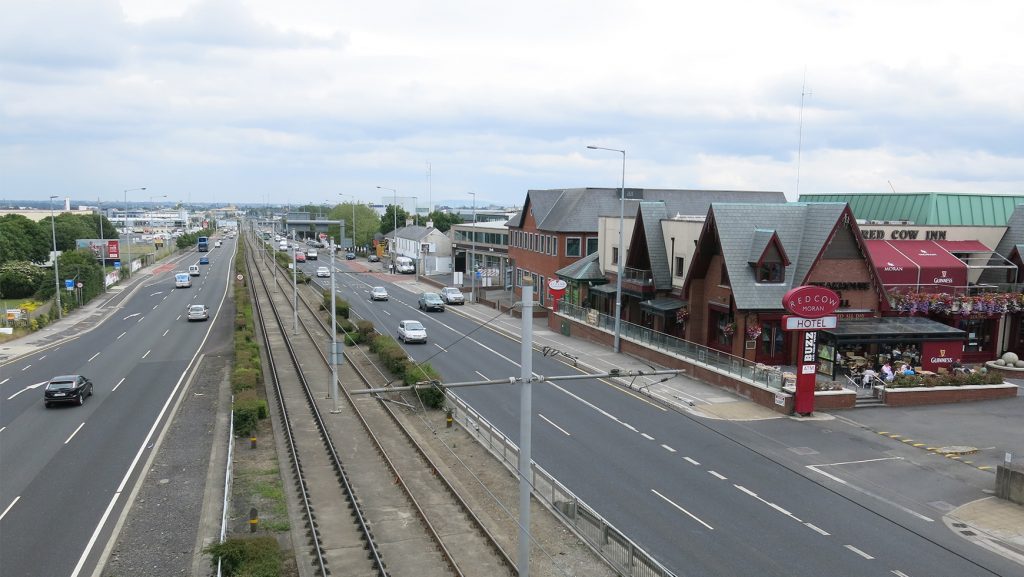
City Edge is one of the most ambitious regeneration projects ever undertaken in Ireland. Launched in 2021, it is a partnership between South Dublin County Council and Dublin City Council to transform a large area of west Dublin around the Naas Road, Ballymount and Park West.
Covering about 700 hectares, City Edge is one of the largest urban regeneration projects currently planned in Europe. Its edge of city location, close to existing and future public transport, presents a once in a generation opportunity to deliver new homes, jobs and communities in a sustainable way.
The long term vision is to transform an area currently dominated by industrial uses, roads and underutilised land into a series of well connected neighbourhoods where people can live, work and access services within a short walk or cycle built on the principles of compact growth, climate resilience, transport orientated development and the “10-minute settlement concept.”

Today, the City Edge area is home to approximately 1,500 businesses and supports around 25,000 jobs, representing a significant contributor to the Dublin and national economy. Over the next 50 years, the planned development of City Edge has the potential to deliver:
- Up to 40,000 new homes
- Up to 75,000 jobs
- An estimated €13 billion GVA per annum contribution to the national economy
This scale of development is essential to meet future housing demand, support economic growth and reduce pressure on the city centre.
Rather than expanding the city outwards, City Edge promotes compact growth, making better use of land close to the city, public transport and services. This approach also supports climate goals by reducing car dependency and encouraging walking, cycling and public transport.
City Edge is being positioned not only as a place to live, but as an economic platform for the wider Dublin region.
Early work focused on a non statutory planning framework published in 2022, setting out a high level vision for long term development. Since then, detailed studies have been completed, including:
- Transport modelling
- Urban design
- Energy analysis
Economic research has also examined existing employment and how jobs could grow and diversify. Importantly, this work recognises the value of existing industrial and employment uses and explores how they can be retained and integrated within a high quality, modern urban environment. While the area comprises over 500-600 individual landowners and some relocation will be necessary, the overarching approach supports the managed evolution of industrial activity into more efficient and compatible forms within a mixed use urban framework.
Moving from vision to delivery
The project has now moved into a delivery phase, with both councils preparing draft statutory plans setting out phased development over time.
City Edge is being positioned not only as a place to live, but as an economic platform for the wider Dublin region, supporting businesses, attracting investment and enabling job creation at scale. Given its size and complexity, development will be phased, beginning with Priority Development Areas (PDAs) selected for their transport access, transformation potential and availability of underused land.
Priority Development Areas:
Within South Dublin County Council, three PDAs have been identified:
- Red Cow & Cherry Orchard
- Longmile
- Greenhills
Together, these areas could provide:
- Around 9,000 homes
- Housing for nearly 25,000 people
- Over 12,000 jobs
Dublin City Council’s plan focuses on the Kylemore area, with potential for:
- 4,000-5,300 homes
- 11,000-14,000 residents
- Around 170,000 square metres of employment space
Key challenges
Delivering City Edge will require long term coordination, investment and commitment from public bodies, infrastructure providers and the private sector. An Infrastructure Delivery Working Group has been established to identify transport, utility and social infrastructure needs and deliver them in a coordinated way.
Transport is central to the plans, with a strong focus on walking, cycling and public transport, supported by mobility hubs and shared parking barns as the area transitions away from car dependency. This is particularly important given Dublin’s congestion performance in late 2025 and early 2026, when the city ranked third globally in the TomTom Traffic Index 2025.
There are also financial and market challenges, and careful management will be required as the area evolves from predominantly employment uses to mixed use neighbourhoods.
The importance
Despite these challenges, City Edge will play a critical role in the Dublin Region’s future economy by diversifying economic geography, supporting emerging sectors, addressing land and housing constraints, and enabling employment growth within a sustainable compact development pattern.
Progressing the statutory plans and implementing City Edge sends a clear signal to investors and international partners that Dublin can plan and deliver complex projects at scale. City Edge should be viewed not simply as a regeneration project, but as essential economic infrastructure supporting Dublin’s long term competitiveness in a global, talent driven and resource constrained environment.
Commercial Development Officer, South Dublin County Council


