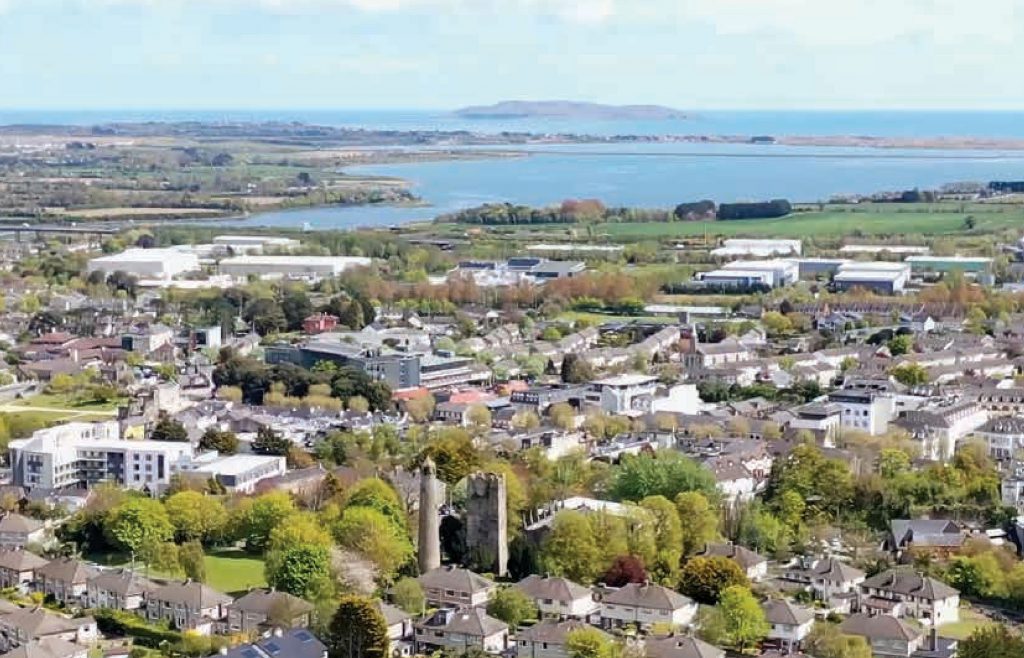
Once a quiet rural town, Balbriggan has undergone a dramatic transformation over the past two decades, emerging as Ireland’s youngest and most diverse town.
At the heart of this evolution is Fingal County Council’s visionary “Our Balbriggan Rejuvenation Plan”, a community-driven strategy to build a vibrant, inclusive, thriving local economy.
Backed by over €25 million from the Urban Regeneration and Development Fund (URDF), the Council is investing more than €50 million into public realm improvements. The flagship project at Quay Street is already underway, set to deliver a new civic plaza, five commercial spaces and a reimagined waterfront by 2026.
Beyond the revitalisation of the town centre, Fingal is positioning Balbriggan as a strategic industrial hub, leveraging the town’s strategic location on the Dublin Belfast Corridor, its excellent proximity to Dublin Airport and Dublin Port, its strong connectivity to the national road network and the rail network with the town primed to take advantage of the DART+ Coastal North Project, which will extend the electrified rail network to Balbriggan, enhancing the town’s connectivity and economic potential.
In the last 3 years, the Council has acquired 200 acres of industrial land to attract investment and drive job creation. Recognising the potential in the designation of Balbriggan as a Decarbonising Zone in the Fingal Climate Action Plan and the rise of offshore wind opportunities, Fingal is positioning Balbriggan as a green industrial cluster and redefining its approach to industrial development through sustainability.
This ambition sparked the creation of the Urbact EcoCore Project, a European initiative led by Fingal – the first Irish local authority to do so. EcoCore brings together small cities across Europe, located along strategic transport corridors to advance the green industrial transition.
Over the last two years Fingal has, through collaboration, pilot actions and a co-creation process involving multi-level, multi-sectoral stakeholders, developed an Integrated Action Plan to shape Balbriggan into a world-class green industrial zone.
Fingal is positioning Balbriggan as a green industrial cluster and redefining its approach to industrial development through sustainability.
Key lessons learned include governance models, green procurement, investment attraction, skills development, carbon impact measurement and promotion of the circular economy. The project has highlighted the critical role of branding and targeted marketing to attract the right investors and the vital importance of engagement with business and education stakeholders.
Balbriggan’s journey is a compelling study in how local leadership, strategic investment and international collaboration can drive sustainable economic transformation.
Through the Future Fingal Economic Development Strategy, Fingal is setting out a roadmap for the county’s future economic development. The Strategy identifies key opportunities and sectors – placing sustainability at the heart of economic transformation. Identified by stakeholders as a key opportunity, sustainability is driving Fingal’s engagement with business.
Fingal’s proactive approach to business engagement is demonstrated with companies like Techrete and A.Forall in Balbriggan sharing their sustainability journeys through video case studies and business briefings facilitating peer to peer learning and exchange. Telling the story of these companies provides inspiration for other companies to start their own sustainability journeys with Fingal fostering a culture of collaboration and supporting businesses to navigate the shift toward greener practices.
Taking business engagement to the next level, Fingal hosted a Hackathon on the Circular Economy to explore the challenges of moving from a linear to circular economic model. Building on work of Dublin Belfast Economic Corridor (DBEC) partners, Fingal is conducting a feasibility study for a circular economy hub and digital platform focused on construction waste with ground-breaking engagement with the construction sector, an initiative which will require regional collaboration within DBEC for economies of scale.
With new obligations under the EU Corporate Social Responsibility Directive (CSRD), Fingal recognises the pressures facing businesses. In response Fingal is engaging with business stakeholders to co-develop the Future Fingal: Sustainable Fingal Strategy to identify how Fingal can support and work in partnership with business, education and community stakeholders to meet climate targets and accelerate the transition to a more sustainable, circular economic model.
Industrial development is evolving. Fingal understands that selling land and streamlining planning isn’t enough. Today’s competitive economic environment demands added value, through collaboration on local climate projects and sustainable transport solutions. Added value means supporting the development of the future talent pipeline and, in Ireland especially, supporting the hundreds of SMEs who lack the resources to navigate the complexities of the upskilling ecosystem. Fingal is leading the way with the Future Fingal: Fingal Skills Strategy, being the first local authority in Ireland to develop a skills strategy, demonstrating the innovation and commitment of Fingal County Council to understanding and responding to business needs.
Looking ahead to 2026, Fingal will unveil new branding for Balbriggan’s industrial zone, positioning Balbriggan for green investment and high value employment. 2026 will also see the launch of the Future Fingal: Sustainable Fingal Strategy, which will affirm the Council’s commitment to supporting businesses to thrive in a low-carbon economy.
Fingal’s approach to economic development is bold, inclusive and future-focused – setting a benchmark for how local government can drive sustainable economic development through innovation, collaboration and strategic foresight.
Follow Fingal’s Economic Development Team on LinkedIn to keep up-to-date with Fingal’s economic development work.